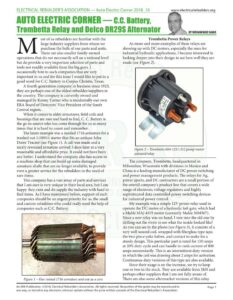
ELECTRICAL REBUILDER’S ASSOCIATION — Auto Electric Corner 2018 _10 www.electricalrebuilders.org AUTO ELECTRIC CORNER — C.-C. Battery, ost of us rebuilders are familiar with the large industry suppliers from whom we purchase the bulk of our parts and units. There are also smaller family-owned operations that do not necessarily sell on a national level but do provide a very important selection of parts and tools not readily available from the big guys. I occasionally hint to such companies that are very important to us and for this issue I would like to put in a good word for C.C. Battery in Corpus Christie, Texas. A fourth generation company in business since 1923, they are perhaps one of the oldest rebuilder/suppliers in the country. The company is currently owned and managed by Kenny Turner who is incidentally our own ERA Board of Directors’ Vice President of the South Central region. When it comes to older armatures, field coils and housings that are rare and hard to find, C. C. Battery is the go-to source who has come through for us so many times that it is hard to count and remember. The latest example was a needed 1716 armature for a trashed out 1108911 starter that fits an antique John Deere Tractor (see Figure 1). A call was made and a nicely rewound armature arrived 3 days later at a very reasonable and affordable price. It could not have been any better. I understand the company also has access to a machine shop that can build up some damaged armature shafts that are no longer available, to provide even a greater service for the rebuilders in the need of rare items. This company has a vast array of parts and services that I am sure is very unique in their local area, but Iam happy they exist and do supply the industry with hard to find items. As I have mentioned before, support of such companies should be an urgent priority for us, the small and custom rebuilders who could really need the help of companies such as C.C. Battery. Figure 1 – Our ruined 1716 armature sent out as a core Trombetta Relay and Delco DR29S Alternator BY MOHAMMAD SAMII Trombetta Power Relays As more and more examples of these relays are showing up with DC motors, especially the ones for industrial hydraulic applications, I became interested in looking deeper into their design to see how well they are made (see Figure 2). Figure 2 – Trombetta 684-1211-212 pump motor solenoid/relay The company, Trombetta, headquartered in Milwaukee, Wisconsin with divisions in Mexico and China is a leading manufacturer of DC power switching and power management products. The relays for Ag, power sports, and DC contractors are a small portion of the overall company’s product line that covers a wide range of electronic voltage regulators and highly sophisticated data-controlled power switching devices for industrial power control. My example was a simple 12V power relay used to operate the DC motor of a hydraulic tail-gate, which had a Mahle MAJ 4519 motor (currently Mahle MM367). Since a new relay was on hand, I tore into the old one by drilling out the rivets to see what the inside looked like! As you can see in the photo (see Figure 3), it consists of a very well wound coil, wrapped with fiberglass type tape, the two-piece yoke halves, and contact to make for a sturdy design. This particular part is rated for 150 amps at 20% duty cycle and can handle in-rush current of 800 amps momentarily. This is an intermittent duty version in which the coil was drawing about 2 amps for activation. Continuous-duty versions of this type are also available. Since their usage is on the increase, we try to keep one or two in the stock. They are available from J&N and perhaps other suppliers that I am not fully aware of. There are also some aftermarket versions of this relay An ERA Publication. ©2018, Electrical Rebuilder’s Association. All rights reserved. No portion of the guide may be reproduced in Page 1 any way, or stored in any electronic retrieval system without the prior written consent of the Electrical Rebuilder’s Association. ELECTRICAL REBUILDER’S ASSOCIATION — Auto Electric Corner 2018_10 www.electricalrebuilders.org AUTO ELECTRIC CORNER Figure 3 – Coil and contact disc of the Trombetta solenoid Figure 4 – 8487 Delco DR29S-type alternator for Hyundai available, but Iam not sure if they can match the precision and durability that the original items are built with. Hyundai/Delco 8487 Alternator From time to time I share the details of certain units that are rare or new to me, to give you a heads-up when such things show up in your shop. I believe having some prior knowledge and information can always be helpful to a rebuilder when encountering unseen units. One such alternator that we have seen a couple of times lately is a Delco 8400206 (Lester 8487). It is referred to as a DR29S type and goes on a 2011-2012 Hyundai Santa Fe, and later Kia Sorento with 3.5L V-6 engines (see Figure 4). This alternator that also goes by Hyundai/Kia numbers of 37700-3C510 and 37700-3C-610, is available mostly at the dealers with a price tag of nearly $400 with very little availability in the aftermarket. The alternator’s plug-code has not been established yet but is very similar to #296, the typical Honda/Toyota square 4-pin plug but with one difference. Where the #296 plug-code has IG – L – C – Fr terminals, the 8487 alternator only has L – C – Fr terminals, meaning the “IG” pin has been replaced by a dummy “D” terminal. The alternator will self-excite with high RPM, but in normal operation and testing it can be excited with a #194 light via the “L” terminal (see Figure 5). For all practical purposes, this alternator can be considered a sort of Hyundai/Kia version of GM’s RVC where changing the pulse-width of the signal applied to “C” (computer or COM) terminal will slightly change the voltage setting of the regulator. More about this when I am done with additional information regarding on-vehi- cle testing and scope captures for a near future article or the next ERA Show. But as I mentioned, activating the “L” terminal via a test light or #194 bulb will suffice for preliminary bench testing which gives you a 14.2 to 14.5V setting. This alternator that is rated at 150-amps and built well with a very elaborate stator winding that contributes to a very strong power curve with minimal ripple (See Figure 6). The negative diodes are built into the SRE housing and the positive part of the rectifier and lead-frame are screwed in the SRE and are replaceable perhaps as a whole SRE assembly. The stator to rectifier leads must be unsoldered to remove the stator from SRE housing. The rotor’s slip ring is similar to the Delco 24-SI and easy to replace. The aftermarket version of the regulator is of course available through our industry suppliers (WAI’s D2298 as an example) but I have not found a suitable brush and method for brush replacement yet. The last photo shows Figure 6 – Multi-row and heavily wound 8487 alternator’ stator An ERA Publication. ©2018, Electrical Rebuilder’s Association. All rights reserved. No portion of the guide may be reproduced in Page 2 any way, or stored in any electronic retrieval system without the prior written consent of the ElectricalPRebuilder’s Association.