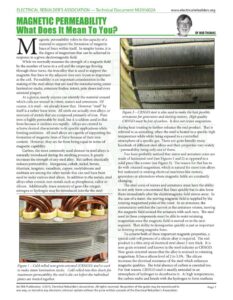
ELECTRICAL REBUILDER’S ASSOCIATION — Technical Document MI201602A www.electricalrebuilders.org MAGNETIC PERMEABILITY What Does It Mean To You? agnetic permeability refers to the capacity of a material to support the formation of magnetic lines of force within itself. In simpler terms, it is the degree of magnetism that can be achieved in response to a given electromagnetic field. While we normally measure the strength of a magnetic field by the number of turns in a coil and the amperage flowing through those turns, the iron alloy that is used to support the magnetic flux lines in the adjacent iron core is just as important as the coil. Permability is an important consideration in the making of the steel alloys that are used for manufacturing stator lamination stacks, armature bodies, rotors, pole shoes and even solenoid plugers. Ata glance, nearly anyone can identify the material around which coils are wound in rotors, stators and armatures. Of course, it is steel – we already know that. However “steel” by itself sj we ie, eae £l pose © actually finn alloys, or Figure 2 – CRNGO steel is also used to make the best possible mixturys 91 feta ss thatare composed primarily of iron, Pure armatures for generators and starting motors. High quality iron is highly permeable by itself, but it is seldom used in that CRNGO must be free of carbon. It does not retain magnetism. form because it oxidizes too rapidly. Alloys are created to achieve desired characteristic to fit specific applications while during heat treating to further enhance the end product. That is limiting oxidation. All steel alloys are capable of supporting the _‘eferred to as annealing, when the steel is heated to a specific high formation of magnetic lines of force because of their iron temperature while while being exposed to a controlled content. However, they are far from being equal in terms of atmosphere of a specific gas. There are quite literally many magnetic capability. hundreds of different steel alloys and their properties vary widely Carbon, the most commonly used element in steel alloys is ~ permeability being only one of them. naturally introduced during the smelting process. It greatly You have probably noticed that stator and armature cores are increases the strength of any steel alloy. But carbon drastically made of laminated steel (see Figures 1 and 2) as opposed to a reduces permeability. Manganese, cobalt, nickel, boron, solid piece like a rotor (see Figure 3). The reason for that has to titanium, tungsten, vanadium, copper, molybdenum and do with retained magnetism, which is natural for most iron alloys niobium are among the other metals that can and have been but undesired in rotating electrical machines like motors, used to make various steel alloys. In addition to the metals, steel ___ Snerators or alternators where magnetic fields are constantly alloys often contain non-metals such as phosphorus, sulfur or changing. silicon. Additionally, trace amounts of gases like oxygen, The steel cores of stators and armatures must have the ability nitrogen or hydrogen may be introduced into the the steel to not only form concentrated flux lines quickly but to also loose them immediately after the electromagnetic field moves away. In the case of a stator, the moving magnetic field is supplied by the rotating magnetized poles of the rotor. In an armature, the commutator switches the current as the armature rotates, moving the magnetic field around the armature with each turn. The steel used in these components must be able to resist retaining magnetism once the magnetic field is moved on to the next segment. That ability to demagnetize quickly is just as important as forming strong magnetic lines. To achieve both of these important magnetic properties, a special cold-roll process of a silicon alloy is required. The end product is a thin strip of electrical steel about 2 mm thick. It is non-grain oriented and known in the steel industry as CRNGO. Non-grain oriented means that the alloy is resistant to retaining magnetism. It has a silicon level of 2 to 3.5%. The silicon increases the electrical resistance of the steel which enhances Figure 1 – Cold-rolled non-grain oriented (CRNGO) steel is used magnetic qualities. The total absence of carbon is essential too. to make stator lamination stacks. Cold-rolled into thin sheets for For that reason, CRNGO steel is usually annealed in an maximum permeability, the steel is die cut before the individual atmosphere of hydrogen to decarburize it. At high temperatures, plates are riveted together. the carbon melts and bonds with the hydrogen to form methane An ERA Publication. ©2015, Electrical Rebuilder’s Association. All rights reserved. No portion of the guide may be reproduced in Page 1 any way, or stored in any electronic retrieval system without the prior written consent of the Electrical Rebuilder’s Association. ELECTRICAL REBUILDER’S ASSOCIATION — Technical Document MI201602A www.electricalrebuilders.org MAGNETIC PERMEABILITY gas, thus removing any remaining carbon. Rotors, pole shoes and solenoid plungers on the other hand are machined from what is called soft iron, which is also free of carbon. It is highly permeable although it will retain some magnetism. Residual magnetism is essential is some of these applications, generators and self exciting alternators in particular. Soft iron alloys may contain some nickel, which further enhances permeability and magetic retention while resisting corrosion. The next time you pick up a rotor, stator or armature, remember that it is not made of just any steel. Figure 3 – Rotor poles are machined from soft iron, which is a carbon free alloy with a high iron content. It will retain magnetism. An ERA Publication. ©2015, Electrical Rebuilder’s Association. All rights reserved. No portion of the guide may be reproduced in Page 2 any way, or stored in any electronic retrieval system without the prior written consent of the Electrical Rebuilder’s Association.