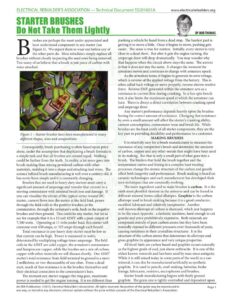
ELECTRICAL REBUILDER’S ASSOCIATION — Technical Document $S201601A www.electricalrebuilders.org STARTER BRUSHES Do Not Take Them Lightly ___ BYBOB THOMAS rushes are perhaps the most under appreciated and pushing a vehicle by hand from a dead stop. The hardest part is least understood component in any starter (see getting it to move a little. Once it begins to move, pushing gets Figure 1). We expect them to wear out before any of easier. The same is true for starters. Initially, every starter is very the other parts do. Most rebuilders simply replace all close to a dead short. But after it gets the engine turning, the brushes without closely inspecting the used ones being removed. | amperage draw will drop dramatically. You may wonder why Too many of us believe that a brush is just piece of carbon with that happens when the circuit above stays the same. The answer wires attached. is that it does not stay the same. It changes the moment the armature moves and continues to change with armature speed. As the armature turns, it begins to generate its own voltage, which is reverse of the applied voltage from the battery. This is often called back voltage or more properly, reverse electro-motive force. Reverse EMF generated within the armature acts as a resistance to current flow during cranking. In a free spin bench test, it also limits the maximum speed at which the armature can turn. There is always a direct correlation between cranking speed and amperage draw. Any starter’s performance depends heavily upon the brushes having the correct amount of resistance. Changing that resistance by even a small amount will affect the starter’s cranking ability, current consumption, commutator wear and brush life. While brushes are the least costly of all starter components, they are the Figure 1 – Starter brushes have been manufactured in many key part in providing durability and performance to a customer. different shapes, sizes and compositions. MAKING BRUSHES It is relatively easy for a brush manufacturer to measure the Consequently, brush purchasing is often based upon price resistance of any competitor’s brush and determine the amounts alone, under the assumption that duplicating a brush formula is of carbon, copper and any other metals that might have been used a simple task and that all brushes are created equal. Nothing in its making. But that is only a small part of what goes into a could be further from the truth. In reality, a lot more goes into brush. The binders that hold the brush together and the brush-making than mixing powdered carbon with other temperature curves and timing in a complex heat treating materials, molding it into a shape and attaching lead wires. The processes change the atomic structure of the carbon and greatly science behind brush manufacturing is well over a century old, it affect both longevity and performance. Brush making is based on has never been simple and it is constantly changing. ceramic technologies and each manufacturer has developed their Brushes that are used in heavy duty starters must carry a own techniques that are constantly evolving. significant amount of amperage and transfer that current to a The main ingredient used to make brushes is carbon. It is the moving commutator with minimal brush loss and damage. If sixth most plentiful element in the universe and can be found in you can visualize the circuit of the typical series-wound DC different mineral forms called allotrpes. Graphite is the carbon starter, current flows into the motor at the field lead, passes allotrope used in brush making because it is a good conductor, through the field coils to the positive brushes, to the excellent lubricant and relatively inexpensive. Another commutator, through the armature’s coils, back to the negative well-known allotrope of carbon is diamond, which just happens brushes and then ground. This could be any starter, but let us to be the exact opposite – a fantastic insulator, hard enough to cut say for example that it is a 12 volt 42MT with a peak output of granite and price prohibitively expensive. Both minerals are 7,300 watts. Operating at 11 volts under load, this starter will comprised entirely of pure carbon atoms but they have been consume over 650 amps, or 325 amps through each brush! naturally exposed to different pressures over thousands of years, Total resistance in any heavy duty starter must be low so causing variations in their crystalline structures. It is the that current can be high. Power is measured in watts, structure of the carbon atoms that determines its allotrope and determined by multiplying voltage times amperage. The field gives graphite its appearance and very unique properties. coils in the 42MT are solid copper, the armature’s commutator All fossil fuels are carbon based and graphite occurs naturally and hairpins are copper, while the brushes are a mix of carbon, as the highest grade of coal, just above anthracite. It is one of the copper with other materials we will discuss shortly. Our 42MT oldest known minerals and has been used by man since antiquity. starter’s total resistance from field terminal to ground is a mere While it is still mined today in some parts of the world as a raw 2 milliohms, or two-thousandths of one ohm. From a dead mineral, it can also be manufactured artificially as synthetic start, much of that resistance is in the brushes themselves and graphite. It is used in pencils, steel-making, batteries, brake their electrical connection to the commutator’s bars. linings, lubricants, resistors, microphones and brushes. The moment any starter engages the ring gear, maximum Starter brush manufacturing begins with finely ground power is needed to get the engine turning. It is no different than graphite. The grain size is tightly controlled and dependent upon An ERA Publication. ©2015, Electrical Rebuilder’s Association. All rights reserved. No portion of the guide may be reproduced in Page 1 any way, or stored in any electronic retrieval system without the prior written consent of the Electrical Rebuilder’s Association.