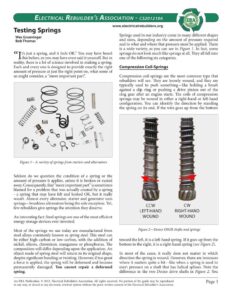
ELecTRICAL REBUILDER’S ASSOCIATION – CS201210A Testing Springs Wes Grueninger Bob Thomas CCTt’s just a spring, and it feels OK” You may have heard this before, or you may have even said it yourself. But in reality, there is a lot of science involved in making a spring. Each and every one is designed to provide exactly the right amount of pressure at just the right point on, what some of us might consider, a “more important part”. Sn ® yo i PT ad Figure 1—A variety of springs from starters and alternators Seldom do we question the condition of a spring or the amount of pressure it applies, unless it is broken or rusted away. Consequently, that “more important part” is sometimes blamed for a problem that was actually created by a spring – a spring that may have felt and looked OK, but it really wasnt. Almost every alternator, starter and generator uses springs—brushless alternators being the sole exception. Yet, few rebuilders give springs the attention they deserve. An interesting fact: Steel springs are one of the most efficient energy storage devices ever invented. Most of the springs we use today are manufactured from steel alloys commonly known as spring steel. This steel can be either high-carbon or low-carbon, with the addition of nickel, silicon, chromium, manganese or phosphorus. The composition will differ depending upon the application. An object made of spring steel will return to its original shape, despite significant bending or twisting. However, if too great a force is applied, the spring will be deformed and become permanently damaged. You cannot repair a deformed spring. An ERA Publication. © 2013, Electrical Rebuilder’s Association. All rights reserved. No portion of the guide may be reproduced in any way, or stored in any electronic retrieval system without the prior written consent of the Electrical Rebuilder’s Association. www.electricalrebuilders.org Springs used in our industry come in many different shapes and sizes, depending on the amount of pressure required and to what and where that pressure must be applied. There is a wide variety, as you can see in Figure 1. In fact, some springs do not look much like springs at all. They all fall into one of the following six categories. Compression Coil-Springs Compression coil-springs are the most common type that rebuilders will see. They are loosely wound, and they are typically used to push something—like holding a brush against a slip ring or pushing a drive pinion out of the ring gear after an engine starts. The coils of compression springs may be wound in either a right-hand or left-hand configuration. You can identify the direction by standing the spring on its end. If the wire goes up from the bottom CCW CW LEFT-HAND RIGHT-HAND WOUND WOUND Figure 2—Denso OSGR shafts and springs toward the left, it is a left-hand spring. If it goes up from the bottom to the right, it is a right-hand spring (see Figure 2). In most of the cases, it really does not matter in which direction the spring is wound. However, there are instances where it matters quite a bit—like when a spring is used to exert pressure on a shaft that has helical splines. Note the difference in the two Denso drive shafts in Figure 2. You Page | ELECTRICAL REBUILDER’s ASSOCIATION – CS201210A can see the CCW drive shaft on the left is used with a left- hand coil spring, and the CW drive shaft on the right uses a right-hand coil spring. This ensures that the spring is not unwound during compression, which would happen if these springs were interchanged. If the spring is unwound during compression, the diameter of the spring will enlarge. This will not only change the pressure being applied by the spring, but it might also allow the spring to slip over its keeper. Extension Springs Extension springs are similar to compression coil-springs, but their coils are wound tightly together, and they pull rather than push. They have been used on some generator and starter applications. On some heavy duty Delco Remy generators, extension springs are used to pull the brush holder towards the commutator. Tecumseh starters used tiny, long, extension springs that stretch around the back of each brush (see Figure 3). Figure 3—Extension springs on Tecumseh starter brush plate Torsion Springs Torsion springs are a little different, as they are made to compress by twisting one end against the other. They have been used in many generators and starters as brush springs. They also come in left-hand and right-hand configurations, but you wont be able to get them mixed up, because they fit only one way (see Figure 4). Flat-Form Springs Flat-form springs have been used in millions of Delco starters from the 1950s through the 1990s. They push the brushes towards the commutator on 5, 8, 10, 15, 20, 25, 27, 30 and 35MT starters. Ford MOD starters also used this type of spring (see Figure 5). An ERA Publication. © 2013, Electrical Rebuilder’s Association. All rights reserved. No portion of the guide may be reproduced Wire-Form Springs Wire-form springs are much less common in rebuilding. A good example we have all been exposed to is the spring used with Hitachi solenoids, which serves as both an indexing spring and a plunger spring. It accomplishes the dual role by applying pressure at the pivot point of the shift lever. This type of spring is difficult to test accurately (see Figure 6). aT Figure 4—Assorted torsion springs <4 FORD DELCO DELCO Figure 5—Delco and Ford flat-form starter brush springs Page 2 in any way, or stored in any electronic retrieval system without the prior written consent of the Electrical Rebuilder’s Association.