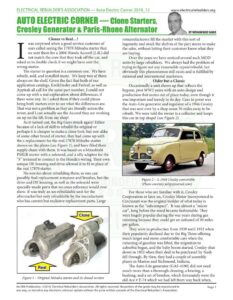
ELECTRICAL REBUILDER’S ASSOCIATION — Auto Electric Corner 2019_12 www.electricalrebuilders.org AUTO ELECTRIC CORNER — Clone Starters, Clones vs Real…! was surprised when a good service customer of ours called saying the 17870 Mitsuba starter that we sent them for a 2004 Honda Accord (2.4L) did not match the core that they took off the car, and asked us to double check if we might have sent the wrong starter. The starter in question isa common one. We have rebuilt, sold, and installed many. We keep two of them always on the shelf. Given the fact that both of our application catalogs, KwikFinder and Partref, as well as Apptrak all call for the same part number, I could not come up with a real explanation about differences, if there were any. So I asked them if they could please bring both starters over to see what the differences are. That was not a problem as they are literally across the street, and I can actually see the Accord they are working on up on the lift, from my shop! As it turned out, the Big Guys struck again! Either because of a lack of skill to rebuild the original or perhaps it is cheaper to make a clone look-but-not-alike of some other brand of starter, they had come up with the a replacement for the real 17870 Mitsuba starter shown on the photo (see Figure 1), and have filled their supply chain with them. It was based on a Mitsubishi PMGR starter with a solenoid, and a silly adaptor for the “S” terminal to connect to the Honda’s wiring. Their own unique DE housing and drive allowed it to fit in place of the real 17870 starter. No worries about rebuilding them, as one can possibly find replacement armature and brushes, but the drive and DE housing, as well as the solenoid were specially-made parts that no cross reference would ever show. It was truly an un-rebuildable unit for the aftermarket but only rebuildable by the manufacturer who has correct but exclusive replacement parts. Large Figure 1 – Original Mitsuba starter and its cloned version Crosley Generator & Paris-Rhone Alternator BY MOHAMMAD SAMII remanufacturers fill the market with this sort of ingenuity and stock the shelves of the part stores to make the sales, without letting their customer know what they are buying. Over the years we have noticed several such MOD units by large rebuilders. We always had the problem of trying to figure out any reasonable repair/rebuild, but obviously this phenomenon still exists and is fulfilled by national and international marketers. Older but a Classic Occasionally a unit shows up that reflects the bygone, post WW2 years with an auto design and production that seems out of place today, even though it was important and trendy in its day. Case in point was the Auto-Lite generator and regulator of a 1946 Crosley that was sent over by a shop some 30 miles away to be rebuilt. We were told the owner is a collector and keeps this car in top shape! (see Figure 2) 3. 4 ee Figure 2 – A 1948 Crosley convertible (Photo courtesy jalopyjournal.com) For those who are familiar with it, Crosley Corporation or later on, Crosley Motor Incorporated in Cincinnati was the original builder of what today is known as the “subcompact”. It was almost a “micro car”, long before the word became fashionable. They were hugely popular during the war years during gas rationing because they could get an unheard of 50 miles per gallon. They were in production from 1939 until 1952 when their popularity declined due to the Big Three offering much larger and more comfortable cars when the rationing of gasoline was lifted, the migration to suburbia began, and the baby boom started. Crosley shut down in 1952 when their deal to be purchased by Nash fell through. By then, they had a couple of assembly plants in Marion and Richmond, Indiana. The Auto-Lite generator (GAS-4190) did not need much more than a thorough cleaning, a bearing, a bushing, and a set of brushes, which fortunately were the old Ace # E-74 which we had left from way back when, An ERA Publication. ©2019, Electrical Rebuilder’s Association. All rights reserved. No portion of the guide may be reproduced in Page 1 any way, or stored in any electronic retrieval system without the prior written consent of the Electrical Rebuilder’s Association. ELECTRICAL REBUILDER’S ASSOCIATION — Auto Electric Corner 2019_12 www.electricalrebuilders.org AUTO ELECTRIC CORNER not remembering the last time they were used! The voltage regulator (VRP-4004F) was solidly built and weighed three times as much as a similar size regulators of these days. It only needed minor adjustment and was set at 7.1V after it was serviced (see Figure 3). The generator had a surprisingly fast cut-in feature that charged almost immediately as it was run with the regulator. That was not surprising because it was physically almost half as long of the small 4-cyl 750CC engine that was common to the later Crosley models (see Figure 4). Crosley automobiles that filled a very special niche in the chronicles of the American Automobile Industry are popular within certain collector circles and some of the more fancier restored Crosleys can go for tens of thousands of dollars. Quite a sum for a car that started selling new for $350 at first, and of course much more in Figure 5 – Paris-Rhone 14893 alternator (Photo courtesy Apptrak) their last years. The founder, Powell Crosley Jr. was an industrialist who amassed lots of money by selling auto parts with his brother and business partner Lewis M. Crosley. They had many other business ventures. A more significant company he established was Crosley Radio Corporation to manufacture cheap radios in the 1920’s and 1930’s. In 1925 they became the largest radio manufacturer in the world. All of that income was used to make Crosley automobiles that was a childhood dream of his. Working on some of this older stuff and learning about their history is a pleasure that is hard to describe. It really shows how far we have come in automotive technology. Paris-Rhone Alternator This brand that has been around for a long time originated in France and the company became a major European manufacturer of rotating electrical during the war and post war years, competing with likes of Robert Bosch, SEV Marchal, Ducellier and others. In the late 70’s they as well as others were purchased and became a part of Valeo as a part of their initial European and later on global expansion. Our (or my) first experience with the more modern version of these alternators that had an integral/bolt-on regulator was their application in Renault automobiles that were sold in limited numbers in the 80’s but did not become a house-hold name. Later versions of these alternators showed up in a few other cars but also in some industrial engines that are still are used in a variety of applications. Some were also was used in some RV’s Figure 4 – Size of the generator as compared to the engine that had Renault diesel engines (see Figure 5). One of the most common regulators used on these An ERA Publication. ©2019, Electrical Rebuilder’s Association. All rights reserved. No portion of the guide may be reproduced in Page 2 any way, or stored in any electronic retrieval system without the prior written consent of the ElectricalPRebuilder’s Association.