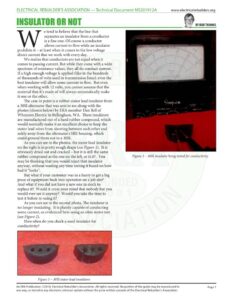
ELECTRICAL REBUILDER’S ASSOCIATION — Technical Document MS201912A www.electricalrebuilders.org INSULATOR OF NOT e tend to believe that the line that separates an insulator from a conductor is a fine one. Of course a conductor allows current to flow while an insulator prohibits it – at least when it comes to the low voltage direct current that we work with every day. We realize that conductors are not equal when it comes to passing current. But while they come with a wide spectrum of resistance values, they all do conduct current. If a high enough voltage is applied (like in the hundreds of thousands of volts used in transmission lines), even the best insulator will allow some current to flow. But even when working with 12 volts, you cannot assume that the material that it’s made of will always automatically make it one or the other. The case in point is a rubber stator lead insulator from a 30SI alternator that was sent to me along with the photos (shown below) by ERA member Dan Bell of Whatcom Electric in Bellingham, WA. ‘These insulators are manufactured out of a hard rubber compound, which would normally make it an excellent choice to keep the stator lead wires from shorting between each other and safely away from the alternator’s SRE housing, which could ground them out in a 30SI. As you can see in the photos, the stator lead insulator on the right is in pretty rough shape (see Figure 1). It is obviously dried out and cracked — but it is still the same rubber compound as the one on the left, or is it?. You Figure 2 – 30SI insulator being tested for conductivity. may be thinking that you would reject that insulator anyway, without wasting any time testing it based on how bad it “looks”. But what if your customer was in a hurry to get a big piece of equipment back into operation on a job site? And what if you did not have a new one in stock to replace it? Would it cross your mind that nobody but you would ever see it anyway? Would you take the time to test it before re-using it? As you can see in the second photo, The insulator is no longer insulating. It is plainly capable of conducting some current, as evidenced here using an ohm meter test (see Figure 2). How often do you check a used insulator for conductivity? Figure 1 – 30SI stator lead insulators An ERA Publication. ©2019, Electrical Rebuilder’s Association. All rights reserved. No portion of the guide may be reproduced in Page 1 any way, or stored in any electronic retrieval system without the prior written consent of the Electrical Rebuilder’s Association.