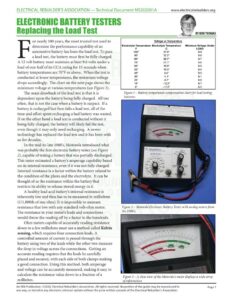
ELECTRICAL REBUILDER’S ASSOCIATION — Technical Document MS202001A www.electricalrebuilders.org ELECTRONIC BATTERY TESTERS Replacing the Load Test “cei 8Y BOB THOMAS or nearly 100 years, the most trusted test used to Voltage vs Temperature determine the performance capability of an Electrolyte pomperature Electrolyte qomperature Minimum Voltage Under automotive battery has been the load test. To pass 100° 37.8° 9.9 a load test, the battery must first be fully charged. 0° on a7 A 12 volt battery must maintain at least 9.6 volts under a 70° 21.1° 9.6 load of one-half of its CCA rating for 15 seconds when a eee aa battery temperatures are 70°F or above. When the test is 40° 44° 9.3 conducted at lower temperatures, the minimum voltage O° oe a drops accordingly. The chart on the next page shows the 10° -12.2° 8.7 minimum voltage at various temperatures (see Figure 1). o 178″ 8.5 The main drawback of the load test is that it is Figure 1 – Battery temperature compensation chart for load testing batteries dependent upon the battery being fully charged. All too often, that is not the case when a battery is suspect. Ifa battery is recharged but then fails a load test, all of the time and effort spent recharging a bad battery was wasted. If on the other hand a load test is conducted without it being fully charged, the battery will likely fail the test, even though it may only need recharging. A newer technology has replaced the load test and it has been with us for decades. In the mid-to-late 1980’s, Motorola introduced what was probably the first electronic battery tester (see Figure MeSwowe waa Tse 2), capable of testing a battery that was partially discharged. This tester estimated a battery’s amperage capability based on its internal resistance, even if it was not fully charged. Internal resistance is a factor within the battery related to the condition of the plates and the electrolyte. It can be thought of as the resistance within the battery that restricts its ability to release stored energy in it. A healthy lead acid battery’s internal resistance is inherently low and thus has to be measured in milliohms (1/1,000th of one ohm). It is impossible to measure resistance that low with any standard volt-ohm meter. Figure 2 – Motorola Electronic Battery Tester with analog meters from The resistance in your meter’s leads and connections geo would throw the reading off by a factor in the hundreds. Ohm meters capable of accurately reading resistance down to a few milliohms must use a method called Kelvin sensing, which requires four connection leads. A amet controlled amount of current is passed through the battery using two of the leads while the other two measure the drop in voltage across the connections. Getting an accurate reading requires that the leads be carefully placed and secured, with each side of both clamps making a good connection. Using this method, both amperage and voltage can be accurately measured, making it easy to calculate the resistance value down to a fraction of a a So RANK ANP? KILOWATTS w No 2 23 4 Is _. Figure 3 – A close view of the Motorola’s meter displays a wide array milliohm. of information An ERA Publication. ©2020, Electrical Rebuilder’s Association. All rights reserved. No portion of the guide may be reproduced in Page 1 any way, or stored in any electronic retrieval system without the prior written consent of the Electrical Rebuilder’s Association. ELECTRICAL REBUILDER’S ASSOCIATION — Technical Document MS202001A www.electricalrebuilders.org ELECTRONIC BATTERY TESTERS ERA member and Exchange contributor Nathan Unger of ASI Rebuilders in Abbottsford, British Columbia wrote an article describing how he built his own low-ohm tester for testing suspect connections. You can find it on the ERA website by searching for “Lord Kelvin”. General MacArthur once said, “Old solders never die, they simply fade away.” You could say the same for most lead acid batteries. As any battery ages, its internal resistance slowly increases and its cold cranking amperage capability fades away accordingly. Having owned and used a Motorola battery tester back in the day, I can testify that it was a helpful tool, capable of testing both 6 and 12 volt batteries. A large analog display provided voltage, CCA, kilowatts and “good” or “replace” in relation to CCA (see Figure 3). You dialed in the battery’s CCA to get that reading. If the needle fell in the red, you could slowly dial the CCA knob back until the needle fell into the “good” range. That would give you the available CCA, which might be helpful information. This tester had a temperature select switch for testing batteries in sub-freezing weather conditions and a setting to estimate the amount of usable energy (in kilowatts) stored in the battery. The meter even told you if the battery was too low to test and needed a charge before testing. In last month’s article on how a battery affects charging voltage, I mentioned that battery conductivity is a better indicator of its condition than internal resistance, although they share an inverse relationship. Motorola sold all rights to their battery tester to Midtronics at some point. Midtronics has since continued to produce and market a line of high quality battery testers. Today they are making use of a newer technology that measures the battery’s conductivity. I wore out two of the old Motorola testers long ago and have since discarded them. But searching online, I found a used one on eBay for $25 with shipping. I also searched the internet for ‘battery testers”, and found dozens of different electronic devices, ranging in price from around $20 to more than $2,000! Midtonics offers a full line of battery testers, all using their patented conductivity testing. I ordered the least expensive one, a Midtronics MPPBT-100 for $135 (see Figure 4) to see how well it would work. MPPBT-100 uses an LED display for voltage and LED lights for “OK”, “Low” battery or “X” not OK. You set the CCA rating using up and down buttons, hit the test button and it displays the outcome almost instantly. “Low” indicates that the battery must be charged before testing. I also purchased a less expensive tester made in China, the Suner Power digital battery analyzer, which uses Kelvin sensing leads to measure internal resistance (see Figure 5). You set the CCA rating, hit the OK button and the LCD screen displays the results (see Figure 6). Each tester was used to check three different batteries. The Deka battery was less than a year old and known to be good. An Interstate battery was over five years old and would not hold a charge for more than a week. A third battery was in an old garden tractor. It had been sitting unused since May, when I bought a new mower, but I charged it before testing it. Here’s what I found: The Motorola tester performed exactly like I remembered it. It passed the year-old Deka battery when set at 500 CCA (see Figure 7) and showed over 7 kW of Figure 5 – Suner Power battery tester An ERA Publication. ©2020, Electrical Rebuilder’s Association. All rights reserved. No portion of the guide may be reproduced in Page 2 any way, or stored in any electronic retrieval system without the prior written consent of the Electrical Rebuilder’s Association.