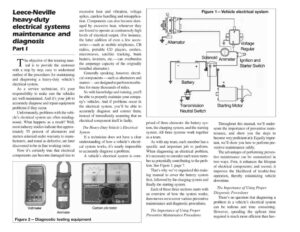
Leece-Neville heavy-duty electrical systems maintenance and diagnosis Part I he objective of this training man- ual is to provide the customer with a step by step, easy to understand outline of the procedures for maintaining and diagnosing a heavy-duty vehicle’s electrical system. As a service technician, it’s your responsibility to make sure the vehicles are well-maintained. And it’s your job to accurately diagnose and repair equipment problems if they occur. Unfortunately, problems with the vehi- cle’s electrical system are often misdiag- nosed. What happens as a result? Well, most industry studies indicate that approx- imately 55 percent of alternators and starters returned under warranty to manu- facturers, and noted as defective, are later discovered to be in fine working order. Now it’s certainly true that electrical components can become damaged due to excessive heat and vibration, voltage spikes, careless handling and misapplica- tion. Components can also become dam- aged by excessive heat, whenever they are forced to operate at continuously high levels of electrical output. (For instance, the latter addition of even a few acces- sories—such as mobile telephones, CB radios, portable CD players, coolers, microwaves, Satellite tracking, bunk heaters, inverters, etc.—can overburden the amperage capacity of the originally installed alternator.) Generally speaking, however, electri- cal components —such as alternators and starters —are designed to perform trouble- free for many thousands of miles. So with knowledge and training, you’ll be able to properly maintain your compa- ny’s vehicles. And if problems occur in the electrical system, you’ll be able to accurately diagnose and correct them, instead of immediately assuming that an electrical component itself is faulty. The Heavy-Duty Vehicle’s Electrical System If a technician does not have a clear understanding of how a vehicle’s electri- cal system works, it’s nearly impossible to accurately diagnose a problem. A vehicle’s electrical system is com- Voltmeter Ammeter Figure 2 — Diagnostic testing equipment Carbon pile tester Transmission Neutral Switch Figure 1— Vehicle electrical system Ignition and Starter Switch Starting Motor prised of three elements: the battery sys- tem, the charging system, and the starting system. All three systems work together as a team. As with any team, each member has a specific and important job to perform. When diagnosing an electrical problem, it’s necessary to consider each team mem- ber as potentially contributing to the prob- lem. See Figure 1, page 7. That’s why we’ve organized this train- ing manual to cover the battery system first, followed by the charging system and finally the starting system. Each of these three sections starts with an overview of how the system works, then moves on to cover various preventive maintenance and diagnostic procedures. The Importance of Using Proper Preventive Maintenance Procedures Throughout this manual, we’ll under- score the importance of preventive main- tenance, and show you the steps to become very proficient at it. Equally impor- tant, we’ll show you how to perform pre- ventive maintenance safely. The advantages of performing preven- tive maintenance can be summarized in two ways. First, it enhances the lifespan of electrical components; and second, it improves the likelihood of trouble-free operation, thereby minimizing vehicle downtime. The Importance of Using Proper Diagnostic Procedures There’s no question that diagnosing a problem in a vehicle’s electrical system can be tedious and time consuming. However, spending the upfront time required is much more efficient than hav-