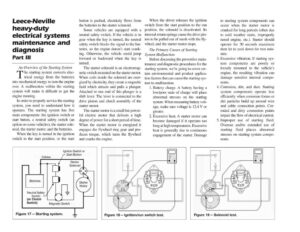
Leece-Neville heavy-duty electrical systems maintenance and diagnosis Part Ill An Overview of the Starting System he starting system converts elec- trical energy from the batteries into mechanical energy to turn the engine over. A malfunction within the starting system will make it difficult to get the engine running. In order to properly service the starting system, you need to understand how it operates. The starting system has five main components: the ignition switch or start button, a neutral safety switch (an option on some vehicles), the starter sole- noid, the starter motor, and the batteries. When the key is turned in the ignition switch to the start position, or the start button is pushed, electricity flows from the batteries to the starter solenoid. Some vehicles are equipped with a neutral safety switch. If the vehicle is in gear when the key is turned, the neutral safety switch blocks the signal to the bat- teries, so the engine doesn’t start crank- ing. Otherwise, the vehicle could jump forward or backward when the key is turned. The starter solenoid is an electromag- netic switch mounted on the starter motor. When coils inside the solenoid are ener- gized by electricity, they create a magnetic field which attracts and pulls a plunger. Attached to one end of this plunger is a shift lever. The lever is connected to the drive pinion and clutch assembly of the starter motor. The starter motor is a small but power- ful electric motor that delivers a high degree of power for a short period of time. When the starter motor is energized it engages the flywheel ring gear and pro- duces torque, which turns the flywheel and cranks the engine. When the driver releases the ignition switch from the start position to the run position, the solenoid is deactivated. Its internal return springs cause the drive pin- ion to be pulled out of mesh with the fly- wheel, and the starter motor stops. The Primary Causes of Starting System Malfunction Before discussing the preventive main- tenance and diagnostic procedures for the starting system, we’re going to cover cer- tain environmental and product applica- tion factors that can cause the starting sys- tem to malfunction. 1. Battery charge. A battery having a low/poor state of charge will place abnormal stresses on the starting system. When measuring battery volt- age, make sure voltage is 12.4 V or greater. 2. Excessive heat. A starter motor can become damaged if it operates too long at high temperatures. Excessive heat is generally due to continuous engagement of the starter. Damage Neutral Safety Switch (or Clutch Switch) Magnetic Switch Figure 17 — Starting system. Ignition Switch or Start Button Starter Solenoid to starting system components can occur when the starter motor is cranked for long periods (often due to cold weather starts, improperly tuned engine, etc.). Starter should operate for 30 seconds maximum then let to cool down for two min- utes. . Excessive vibration. If starting sys- tem components are poorly or loosely mounted to the vehicle’s engine, the resulting vibration can damage sensitive internal compo- nents. 4. Corrosion, dirt, and dust. Starting system components operate less efficiently when corrosion forms or dirt particles build up around wire and cable connection points. Cor- roded and dirty connection points impair the flow of electrical current. .Improper use of starting fluid. Overuse and/or extended use of starting fluid places abnormal stresses on starting system compo- nents. Figure 18— Ignition/run switch test. Figure 19 — Solenoid test.