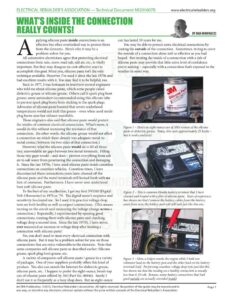
ELECTRICAL REBUILDER’S ASSOCIATION — Technical Document MI201607B www.electricalrebuilders.org WHAT’S INSIDE THE CONNECTION REALLY COUNTS! pplying silicone paste inside connections is an effective but often overlooked way to protect them from the elements. Here’s why it may be a problem-solver for you. All automotive electricians agree that protecting electrical connections from rain, snow, road salt, salt air, etc., is vitally important. But they may disagree on cost-effective ways to accomplish this goal. Mind you, silicone paste isn’t the only technique available. However, I’ve used it since the late 1970s and had excellent results with it. You may find it to be helpful, too. Back in 1977, I was fortunate to interview several engineers who told me about silicone paste, which some people called dielectric grease or silicone grease. Others call it spark plug boot grease; some automakers recommended using this silicone lube to prevent spark plug boots from sticking to the spark plugs. Advocates of silicone paste boasted that severe underhood temperatures would not melt this grease – even when used inside plug boots near hot exhaust manifolds. Those engineers also said that silicone paste would protect the insides of common electrical connections. What’s more, it would do this without increasing the resistance of that connection. (In other words, the silicone grease would not affect a connection on which there already was adequate metal-to- metal contact between the two sides of that connection.) However, what the silicone paste would do is fill all those tiny, unavoidable air gaps between two metal terminals. Filling those tiny gaps would – and does – prevent everything from salt air to salt water from penetrating the connection and damaging it. Since the late 1970s, I have used silicone paste inside countless connections on countless vehicles. Countless times, I have disconnected these connections years later; cleaned off the silicone paste and the metal terminals still looked fresh with no hint of corrosion. Furthermore, I have never seen underhood heat melt silicone paste. To the best of my recollection, I got my first DVOM (Digital Volt-Ohmmeter) in 1978 or 79. The digital meter’s response and sensitivity fascinated me. So I used it to practice voltage drop tests on both healthy as well as suspect connections. (This means turning on the circuit and measuring the voltage change across a connection.) Repeatedly, I experimented by opening good connections, treating them with silicone paste and checking voltage drop a second time. Since the late 1970’s, I have never, ever measured an increase in voltage drop after treating a connection with silicone paste! No, you don’t need to treat every electrical connection with silicone paste. But it may be a problem solver for you on those connections that are extra-vulnerable to the elements. Note that some companies sell silicone paste as described earlier: Silicone grease, spark plug boot grease, etc. A variety of companies sell silicone paste / grease in a variety of packages. One of your suppliers probably offers this kind of product. You also can search the Internet for dielectric grease, silicone paste, etc. I happen to prefer the eight-ounce, brush-top can of silicone paste offered by 3M (Part No. 08946). Surely I don’t use it as frequently as a busy shop does. But an eight-ounce BY DAN MARINUCCI = can has lasted 10 years for me. You may be able to protect some electrical connections by coating the outside of the connection. Sometimes, trying to cover the outside of a connection alone isr’t as effective as you had hoped. But treating the inside of a connection with a dab of silicone paste may provide that little extra level of confidence youre seeking – especially with a connection that’s exposed to the weather in some way. Figure 1 – Here’s an eight-ounce can of 3M’° version of the silicone paste or dielectric grease. Today, this costs approximately 25 bucks – but it works and lasts! Figure 2 – This is common Honda battery terminal that I have cleaned and treated with a film of silicone paste. Years of experience has shown me that I remove the battery cables from this battery years from now, the battery post will still look just like this one. Figure 3 – Here, a helper cranks the engine while I hold one voltmeter lead on the battery post and the other lead on the battery terminal itself. Performing countless voltage drop tests just like this has shown me that the reading on a healthy connection is usually less than 0.10 volt. Beware, many battery connections that look good outside are actually corroded inside! An ERA Publication. ©2015, Electrical Rebuilder’s Association. All rights reserved. No portion of the guide may be reproduced in Page 1 any way, or stored in any electronic retrieval system without the prior written consent of the Electrical Rebuilder’s Association.