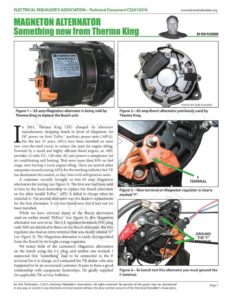
ELECTRICAL REBUILDER’S ASSOCIATION—Technical Document CS201507A www.electricalrebuilders.org MAGNETON ALTERNATOR Figure 1— 65 amp Magneton alternator is being sold by Thermo King to replace the Bosch unit. n 2011, Thermo King (TK) changed its alternator manufacturer, dropping Bosch in favor of Magneton, for DC power on their TriPac™ auxiliary power units (APUs). For the last 15 years, APUs have been installed on most new over-the-road trucks to reduce the need for engine idling. Powered by a small and highly efficient diesel engine, an APU provides 12 volts DC, 120 volts AC and powers a compressor for air conditioning and heating. That saves more than 85% on fuel usage, over leaving a truck engine idling. There are several other companies manufacturing APUs for the trucking industry, but TK has dominated this market, as they have with refrigeration units. A customer recently brought us two 65 amp Magneton alternators for testing (see Figure 1). The first one had been sold to him by the local dealership to replace the Bosch alternator on his older model TriPac™ APU. It failed to charge when he installed it. The second alternator was the dealer’s replacement for the first alternator. It too was brand new, but it had not yet been installed. While we have serviced many of the Bosch alternators used on earlier model TriPacs™ (see Figure 2), this Magneton alternator was new to us. The S-L regulator terminals (PIC plug code 360) are identical to those on the Bosch alternator. But this regulator also had an extra terminal that was clearly labeled “F” (see Figure 3). The Magneton alternator is easily distinguished from the Bosch by its bright orange regulator. We tested both of the customer’s Magneton alternators on the bench using the S-L plug, and neither one worked. I suspected that “something” had to be connected to the F terminal for it to charge, so I contacted the TK dealer, who also happened to be an occasional customer. It pays to have a good relationship with equipment dealerships. He gladly supplied the applicable TK service bulletins. something new from Thermo King BY KEN PLOURDE Figure 2—65 amp Bosch alternator previously used by Thermo King. Figure 3—New terminal on Magneton regulator is clearly marked “F”. Figure 4—To bench test this alternator you must ground the F terminal. An ERA Publication. ©2015, Electrical Rebuilder’s Association. All rights reserved. No portion of the guide may be reproduced Page 1 in any way, or stored in any electronic retrieval system without the prior written consent of the Electrical Rebuilder’s Association. ELECTRICAL REBUILDER’S ASSOCIATION—Technical Document CS201507A www.electricalrebuilders.org After reading TK service bulletin TT610-1, which covers the use of the Magneton alternators on older applications, we managed to get to the root of the problem. If you bench test this alternator, it will not charge unless you ground the F terminal (see Figure 4). To make it operate on the APU, the F terminal must be grounded with a jumper wire (there is one exception that is explained below). Interestingly, no instructions were provided with either alternator. Who would expect a terminal labeled F to require a ground wire? In the service bulletin, this terminal was referred to repeatedly as F2. I suspect that other rebuilders may run into this same scenario. The voltage set point of the orange Magneton alternator is 14.5 volts. Our solution in this case was to rebuild the original Bosch alternator that had already been removed from the machine. That saved the customer money and made the job more profitable for us at the same time. The TK service bulletins also provided some other good information about the Magneton alternators. All TriPac™ APU applications, including late model TriPac™ Evolutions, require a CCW fan for cooling (see Figure 5). This alternator mounts on the back side of the engine and turns with opposite rotation as a result. This CCW fan is unique to the APU. Other TK applications use similar alternators with CW fans. Those applications also have Magneton replacements with different voltage regulators that have a lower set point of 14.0 volts. Obviously, using the wrong fan will cause overheating with any alternator. There are three different configurations of the Magneton alternator that can be used on TriPac™ APUs. The one in the first photo is the 65 amp model. There are also two 120 amp configurations. One of them is a single output, while the other one is referred to as dual output. This confused me and will likely confuse other rebuilders who think of “dual output” as having two isolated B+ terminals. Quite plainly, there is only one B+ terminal on any of the Magneton alternators. In this case, dual output means two amperage capabilities. The single output 120 amp alternator can be used to upgrade the earlier model TriPac™. The dual output 120 amp alternator should not be used in an upgrade, because there are other parts involved in a dual output configuration. The dual output 120 amp Magneton alternator is part of a factory installed charging system and requires the other parts in order to work properly. An alternator from this application must be replaced with either Thermo-King Part #41-9210 or #41-9925 dual output alternator. These alternators have a field F terminal on the voltage regulator just like the other units already mentioned. But in this case, the F terminal must be connected to the adaptive alternator relay (AAR) and resistor harness. If it is not connected, the alternator cannot charge. If a single output 120 amp alternator from a truck/trailer application is installed and connected to the AAR harness it will fail prematurely. The AAR harness includes a relay and a ceramic resistor Figure 5—All Thermo King TriPac™ APU alternators must have a CCW fan for proper cooling. mounted near the engine air cleaner on the APU’s back panel. The harness will attach to the alternator’s F terminal. Check for this harness when replacing an alternator on an Evolution model Thermo-King TriPac™ APU. Units with this application have a high maximum amperage output. However, when the air conditioner compressor clutch is energized, the AAR reduces amperage output by 50% by changing resistance between the F terminal and ground. This is done to control mechanical loads on the APU engine as part of the emissions control system. You should never install a ground jumper wire to the F terminal on the dual output alternator. Doing so will put the APU’s emissions out of compliance and could result in fines. We discovered that the F terminal on all of the orange Magneton regulators is a direct connection to the negative brush. These regulators are B-circuit, controlling on the positive side of the field. Connecting the F terminal to ground simply allows the alternator to operate normally. But in dual output applications, when the AC compressor is engaged, the relay changes the alternator’s field path to ground and runs it through the ceramic resistor. This adds resistance to the field circuit outside of the alternator. That drops the amount of current that can flow through the rotor which reduces magnetic force and maximum output. At the same time, it limits the mechanical load of the alternator on the engine, which in turn keeps the engine’s emissions within legal limits. If you are attempting to service a dual output charging system, I strongly advise that you refer to TK service bulletin TT-674 which covers the dual output system on the TriPac™ Evolution. Call Ken Plourde or the ERA tech help line if you need a copy of either TSB. Ken Plourde is the owner of Guy’s Electric Service, Windsor, Conn. 860-528-8174 An ERA Publication. ©2015, Electrical Rebuilder’s Association. All rights reserved. No portion of the guide may be reproduced Page 2 in any way, or stored in any electronic retrieval system without the prior written consent of the Electrical Rebuilder’s Association.